STENCIL GRAFFITI DEFINITION
back to top
Stencil graffiti, serigraffiti or pochoir Seems
to appear on a wider scale in Paris, mid-1980:s, and soon thereafter
in Berlin and New York. It is usually executed by academic trained artists,
albeit this is an illegal art form.
The ìstencilî could be either negative or positive, and it is commonly cut out in cardboard, plastic or metal to leave a pattern, a text or a picture on the wall, sometimes repeated and varied; it is set tight up on the wall and held steadily while spray painted.
The ìstencilî could be either negative or positive, and it is commonly cut out in cardboard, plastic or metal to leave a pattern, a text or a picture on the wall, sometimes repeated and varied; it is set tight up on the wall and held steadily while spray painted.
Well known stencil artist are Blek le Rat in France,
Die Bananen Sprayer in Germany and John Fekner in USA, but there are
hundreds of others major or minor stencil artists too.
Lit.: Huber, Joerg: Serigraffitis. Hazan, Paris 1986. and Robinson, David: SoHo Walls. T&H, N.Y. 1990.
Source: The International Dictionary of Aerosol Art
Lit.: Huber, Joerg: Serigraffitis. Hazan, Paris 1986. and Robinson, David: SoHo Walls. T&H, N.Y. 1990.
Source: The International Dictionary of Aerosol Art
DOWNLOADS
back to top
STENCILBOARD FONT
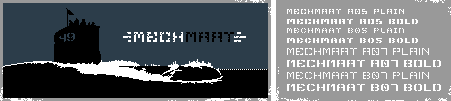
Try and download the stencilboard multitalent:
MECHMAAT stencil- and pixelfont at once.
Free font family with 8 styles.
open the MECHMAAT download-page
MECHMAAT stencil- and pixelfont at once.
Free font family with 8 styles.
open the MECHMAAT download-page
STENCILBOARD WALLPAPER

1024px
X 768px
1280px
X 1024px

1024px
X 768px
1280px
X 1024px

1024px
X 768px
1280px
X 1024px


What is RSS, XML syndicated feeds?
RSS lets you take news feeds and view them together in a simple, ad-free list, so you can quickly find all the articles that interest you from across the web.
How do I subscribe to them?
You will need an RSS Aggregator to subscribe and gather your feeds:
FeedDemon
RSS Reader
NetNewsWire (Mac OS X)
RSS lets you take news feeds and view them together in a simple, ad-free list, so you can quickly find all the articles that interest you from across the web.
How do I subscribe to them?
You will need an RSS Aggregator to subscribe and gather your feeds:
FeedDemon
RSS Reader
NetNewsWire (Mac OS X)
To subscribe to the stencilboard
rss feed use the following address:
http://www.stencilboard.at/rss
If you would like to learn more about RSS:
http://en.wikipedia.org/wiki/RSS
http://www.stencilboard.at/rss
If you would like to learn more about RSS:
http://en.wikipedia.org/wiki/RSS
CONTACT INFORMATION
back to top
This website "stencilboard.at" went online in 2004 and was one of the first platforms to enable the collaborative collection of stencil graffiti. Users from all over the world could photograph and upload stencils they had discovered in public spaces – an open archive of urban visual culture that grew into a remarkable collection over the years. The site was awarded the Prix Ars Electronica in the Digital Community category for this participatory concept.
Over time, however, the habits of the online community have changed significantly. Whereas initially there was lively exchange and many uploads, participation is now much lower. The site has transformed from a lively, growing project into a historical document. That is precisely why it remains online and is technically maintained – as a testament to an early form of digital collaboration and as an archive of an urban art movement.
Stefan Eibelwimmer, Günther Kolar
Over time, however, the habits of the online community have changed significantly. Whereas initially there was lively exchange and many uploads, participation is now much lower. The site has transformed from a lively, growing project into a historical document. That is precisely why it remains online and is technically maintained – as a testament to an early form of digital collaboration and as an archive of an urban art movement.
Stefan Eibelwimmer, Günther Kolar
DISCLAIMER
back to top
The collected material is only meant for viewing
and artistic reflection.
By no means do we want to evoke illegal actions.
The operators of stencilboard are neither the artists of the exhibited illegal works of art, nor are they known to them.
By no means do we want to evoke illegal actions.
The operators of stencilboard are neither the artists of the exhibited illegal works of art, nor are they known to them.
